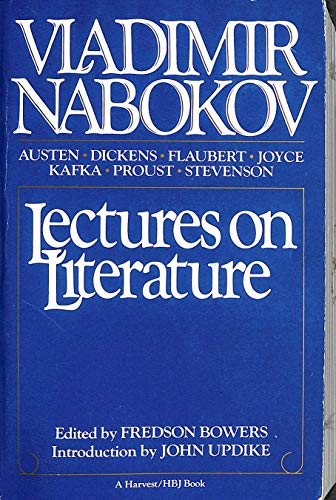
Some readers may suppose that such things as these evocations are trifles not worth stopping at; but literature consists of such trifles. Literature consists, in fact, not of general ideas but of particular revelations, not of schools of thought but of individuals of genius. Literature is not about something: it is the thing itself, the quiddity. Without the masterpiece, literature does not exist.
Curiously enough, one cannot read a book; one can only reread it. A good reader, a major reader, and active and creative reader is a rereader.
“Frankly, I am not one of those college professors who coyly boasts of enjoying detective stories —they are too badly written for my taste and bore me to death."
I don't know if you read a couple of years ago in the papers about that teenage girl and boy who murdered the girl's mother. It starts with a very Kafkaesque scene: the girl's mother has come home and found her daughter and the boy in the bedroom, and the boy has hit the mother with a hammer—several times—and dragged her away. But the woman is still thrashing and groaning in the kitchen, and the boy says to his sweetheart, ''Gimme that hammer. I think I'll have to knock her again." But the girl gives her mate a knife instead and he stabs the girl's mother many, many times, to death—under the impression, probably, that this all is a comic strip: you hit a person, the person sees lots of stars and exclamation marks but revives by and by, in the next installment. Physical life however has no next installment, and soon boy and girl have to do something with dead mother. "Oh, plaster of paris, it will dissolve her completely!" Of course, it will—marvelous idea—place body in bathtub, cover with plaster, and that's all. Meanwhile, with mother under the plaster (which does not work—wrong plaster, perhaps) boy and girl throw several beer parties. What fun! Lovely canned music, and lovely canned beer. "But you can't go, fellas, to the bathroom. The bathroom is a mess."
“Curiously enough, Gregor the beetle never found out that he had wings under the hard covering of his back. (This is a very nice observation on my part to be treasured all your lives. Some Gregors, some Joes and Janes, do not know that they have wings.)”
“That he has disappeared as a human brother and should now disappear as a beetle deals Gregor the last blow.”
on joyce: “Incomplete, rapid, broken wording rendering the so-called stream of consciousness, or better say the stepping stones of consciousness”
In the fall of 1811 Noah Webster, working steadily through the Cs, defined commonsense as "good sound ordinary sense . . . free from emotional bias or intellectual subtlety . . . horse sense." This is rather a flattering view of the creature, for the biography of commonsense makes nasty reading. Commonsense has trampled down many a gentle genius whose eyes had delighted in a too early moonbeam of some too early truth; commonsense has back-kicked dirt at the loveliest of queer paintings because a blue tree seemed madness to its well-meaning hoof; commonsense has prompted ugly but strong nations to crush their fair but frail neighbors the moment a gap in history offered a chance that it would have been ridiculous not to exploit. Commonsense is fundamentally immoral, for the natural morals of mankind are as irrational as the magic rites that they evolved since the immemorial dimness of time. Commonsense at its worst is sense made common, and so everything is comfortably cheapened by its touch. Commonsense is square whereas all the most essential visions and values of life are beautifully round, as round as the universe or the eyes of a child at its first circus show.
It is instructive to think that there is not a single person in this room, or for that matter in any room in the world, who, at some nicely chosen point in historical space-time would not be put to death there and then, here and now, by a commonsensical majority in righteous rage. The color of one’s creed, neckties, eyes, thoughts, manners, speech, is sure to meet somewhere in time or space with a fatal objection from a mob that hates that particular tone. And the more brilliant, the more unusual the man, the nearer he is to the stake. Stranger always hymes with danger. The meek prophet, the enchanter in his cave, the indignant artist, the nonconforming little schoolboy, all share in the same sacred danger. And this being so, let us bless them, let us bless the freak; for in the natural evolution of things, the ape would perhaps never have become man had not a freak appeared in the family. Anybody whose mind is proud enough not to breed true secretly carries a bomb at the back of his brain; and so I suggest, just for the fun of the thing, taking that private bomb and carefully dropping it upon the model city of commonsense. In the brilliant light of the ensuing explosion many curious things will appear; our rarer senses will supplant for a brief spell the dominant vulgarian that squeezes Sinbad’s neck in the catch-as-catch-can match between the adopted self and the inner one. I am triumphantly mixing metaphors because that is exactly what they are intended for when they follow the course of their secret connections—which from a writer’s point of view is the first positive result of the defeat of commonsense.
The second result is that the irrational belief in the goodness of man (to which those farcical and fraudulent characters called Facts are so solemnly opposed) becomes something much more than the wobbly basis of idealistic philosophies. It becomes a solid and iridescent truth. This means that goodness becomes a central and tangible part of one's world, which world at first sight seems hard to identify with the modern one of newspaper editors and other bright pessimists, who will tell you that it is, mildly speaking, illogical to applaud the supremacy of good at a time when something called the police state, or communism, is trying to turn the globe into five million square miles of terror, stupidity, and barbed wire. And they may add that it is one thing to beam at one’s private universe in the snuggest nook of an unshelled and well-fed country and quite another to try and keep sane among crashing buildings in the roaring and whining night. But within the emphatically and unshakably illogical world which I am advertising as a home for the spirit, war gods are unreal not because they are conveniently remote in physical space from the reality of a reading lamp and the solidity of a fountain pen, but because I cannot imagine (and that is saying a good deal) such circumstances as might impinge upon the lovely and lovable world which quietly persists, whereas I can very well imagine that my fellow dreamers, thousands of whom roam the earth, keep to these same irrational and divine standards during the darkest and most dazzling hours of physical danger, pain, dust, death.
What exactly do these irrational standards mean? They mean the supremacy of the detail over the general, of the part that is more alive than the whole, of the little thing which a man observes and greets with a friendly nod of the spirit while the crowd around him is being driven by some common impulse to some common goal. I take my hat off to the hero who dashes into a burning house and saves his neighbor’s child; but I shake his hand if he has risked squandering a precious five seconds to find and save, together with the child, its favorite toy. I remember a cartoon depicting a chimney sweep falling from the roof of a tall building and noticing on the way that a sign-board had one word spelled wrong, and wondering in his headlong flight why nobody had thought of correcting it. In a sense, we all are crashing to our death from the top story of our birth to the flat stones of the churchyard and wondering with an immortal Alice in Wonderland at the patterns of the passing wall. This capacity to wonder at trifles—no matter the imminent peril—these asides of the spirit, these footnotes in the volume of life are the highest forms of consciousness, and it is in this childishly speculative state of mind, so different from commonsense and its logic, that we know the world to be good.
In this divinely absurd world of the mind, mathematical symbols do not thrive. Their interplay, no matter how smoothly it works, no matter how dutifully it mimics the convolutions of our dreams and the quantums of our mental associations, can never really express what is utterly foreign to their nature, considering that the main delight of the creative mind is the sway accorded to a seemingly incongruous detail over a seemingly dominant generalization. When commonsense is ejected together with its calculating machine, numbers cease to trouble the mind. Statistics pluck up their skirts and sweep out in a huff. Two and two no longer make four, because it is no longer necessary for them to make four. If they had done so in the artificial logical world which we have left, it had been merely a matter of habit: two and two used to make four in the same way as guests invited to dinner expect to make an even number. But I invite my numbers to a giddy picnic and then nobody minds whether two and two make five or five minus some quaint fraction. Man at a certain stage of his development invented arithmetic for the purely practical purpose of obtaining some kind of human order in a world which he knew to be ruled by gods whom he could not prevent from playing havoc with his sums whenever they felt so inclined. He accepted that inevitable indeterminism which they now and then introduced, called it magic, and calmly proceeded to count the skins he had bartered by chalking bars on the wall of his cave. The gods might intrude, but he at least was resolved to follow a system that he had invented for the express purpose of following it. Then, as the thousands of centuries trickled by, and the gods retired on a more or less adequate pension, and human calculations grew more and more acrobatic, mathematics transcended their initial condition and became as it were a natural part of the world to which they had been merely applied. Instead of having numbers based on certain phenomena that they happened to fit because we ourselves happened to fit into the pattern we apprehended, the whole world gradually turned out to be based on numbers, and nobody seems to have been surprised at the queer fact of the outer network becoming an inner skeleton. Indeed, by digging a little deeper somewhere near the waistline of South America a lucky geologist may one day discover, as his spade rings against metal, the solid barrel hoop of the equator.
And inversely, there is nothing dictators hate so much as that unassailable, eternally elusive, eternally provoking gleam. One of the main reasons why the very gallant Russian poet Gumilev was put to death by Lenin’s ruffians thirty odd years ago was that during the whole ordeal, in the prosecutor’s dim office, in the torture house, in the winding corridors that led to the truck, in the truck that took him to the place of execution, and at that place itself, full of the shuffling feet of the clumsy and gloomy shooting squad, the poet kept smiling.
At the bottom of the scale a very mild kind of thrill can be experienced by a minor writer noticing, say, the inner connection between a smoking factory chimney, a stunted lilac bush in the yard, and a pale-faced child; but the combination is so simple, the threefold symbol so obvious, the bridge between the images so well-worn by the feet of literary pilgrims and by cartloads of standard ideas, and the world deduced so very like the average one, that the work of fiction set into motion will be necessarily of modest worth
Now the course comes to a close. The work with this group has been a particularly pleasant association between the fountain of my voice and a garden of ears—some open, others closed, many very receptive, a few merely ornamental, but all of them human and divine. Some of you will go on reading great books, others will stop reading great books after graduation; and if a person thinks he cannot evolve the capacity of pleasure in reading the great artists, then he should not read them at all. After all, there are other thrills in other domains: the thrill of pure science is just as pleasurable as the pleasure of pure art. The main thing is to experience that tingle in any department of thought or emotion. We are liable to miss the best of life if we do not know how to tingle, if we do not learn to hoist ourselves just a little higher than we generally are in order to sample the rarest and ripest fruit of art which human thought has to offer.